Build a Subscription Recipe Community Around Your Cooking Channel
Summary
If you have been creating cooking videos for a few years, you have probably built something more valuable than a collection of uploads. You have an audience that knows your food, trusts your recipes and comes back to see what you make next. The opportunity is to turn some of those viewers into members of a community you have a direct relationship with.
OurRecipes is built around that idea. Keep using YouTube, Instagram and TikTok for discovery, but give your recipes and your audience a permanent home of their own. Your Kitchen becomes a searchable recipe library where viewers can save and cook your recipes, join your private community and, for your most loyal followers, subscribe for additional content and access.
The goal isn't to replace your channel. It is to build something around it that you actually own.
Your channel already has the beginnings of a membership business
Most established cooking creators already have a core group of people who watch regularly, cook their recipes and recognize them when they show up in the feed. The problem is that almost all of that relationship takes place inside platforms designed around the next piece of content.
You publish a video, people watch it, some subscribe, and then the feed moves on. Even someone who loves your cooking may never see the next thing you publish unless an algorithm decides to put it in front of them.
There is another way to think about that audience. Someone discovers you on YouTube, watches you make dinner, opens the recipe and saves it. A week later they come back looking for something else to cook. Over time, they may want your new recipes delivered directly, access to your full collection, or a place where they can ask questions and interact with other people who cook your food.
At that point they are no longer just another viewer passing through a feed. They are becoming part of your community. The idea is not to move people away from your channel, but to give the people who care about your work somewhere useful to go next.
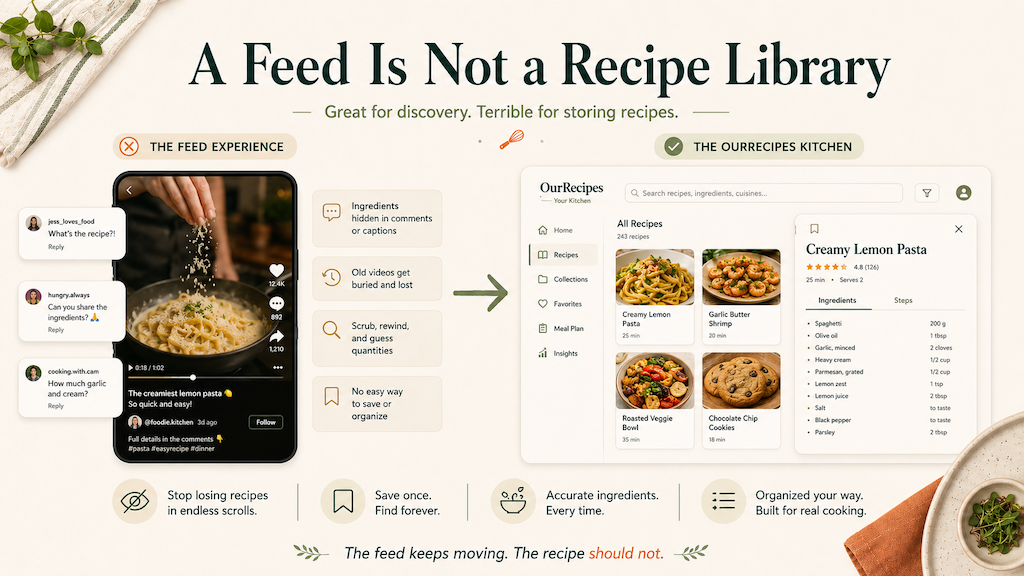
A feed is not a recipe library
Video is an amazing way to teach someone how to cook. It is a surprisingly bad way to store a recipe.
Food creators hear the same questions constantly: Where's the recipe? How much garlic did you use? Can I substitute this? Didn't you make something like this last year?
The frustrating part is that the answer usually already exists. You explained the ingredients while filming, demonstrated the technique and may even have written part of the recipe in the description. But when somebody actually wants to cook the dish two months later, they are searching through old videos, descriptions, comments and timestamps trying to reconstruct it.
That is because YouTube, Instagram and TikTok were designed primarily as feeds. Their job is to keep showing people what is new. Recipes work differently. A good recipe may be just as useful three years from now as it was the afternoon you uploaded the video.
Your videos should keep doing what video does best while the recipes themselves live somewhere designed for people who actually want to cook them.
You shouldn't have to become a food blogger
For years, the obvious answer was to build a website and write a blog post for every video. That works perfectly well if you actually want to run a food blog, but many of today's best cooking creators chose video precisely because writing blog posts wasn't what they wanted to spend their time doing.
They want to develop dishes, cook, teach and entertain. After filming and editing a video, sitting down to reconstruct the same recipe again inside WordPress feels like doing the work twice.
The useful thing about cooking videos is that much of the recipe is already there. Ingredients, quantities, timing, steps and technique can be extracted into a first draft. The creator can then review it, fix anything that needs fixing and add the details that come from actually knowing the dish.
Software should remove the repetitive work from publishing a recipe. It shouldn't pretend it knows how you cook.
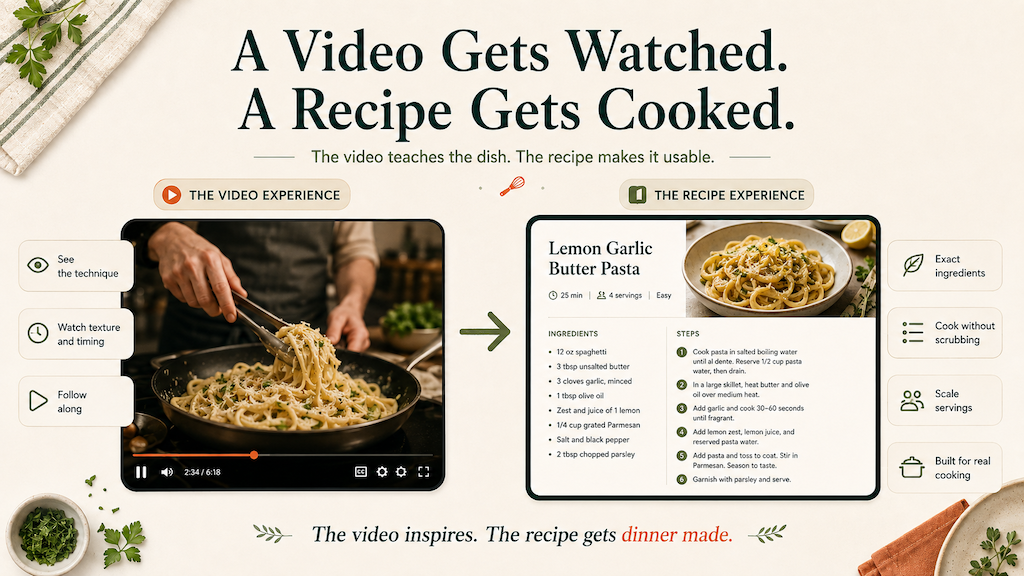
A video gets watched. A recipe gets cooked.
Written recipes and cooking videos are sometimes treated as competing formats, but in practice they are useful at different moments.
Video is wonderful when somebody is learning a technique. You can see what properly browned butter looks like, how loose a dough should feel, how finely an onion is chopped or how aggressively a sauce should be simmering. Those details are difficult to communicate as effectively in a few sentences.
But when it is six o'clock and someone is standing at the stove making dinner, their needs change. They want to glance at an ingredient list, check the next step and confirm whether you said one teaspoon or one tablespoon. Scrubbing backward through an eight-minute video is not a particularly good interface for that.
The best experience keeps the two connected: watch the video when you want to understand how the dish is made, then use the written recipe when you are actually cooking it.
Your back catalog may be your most valuable starting point
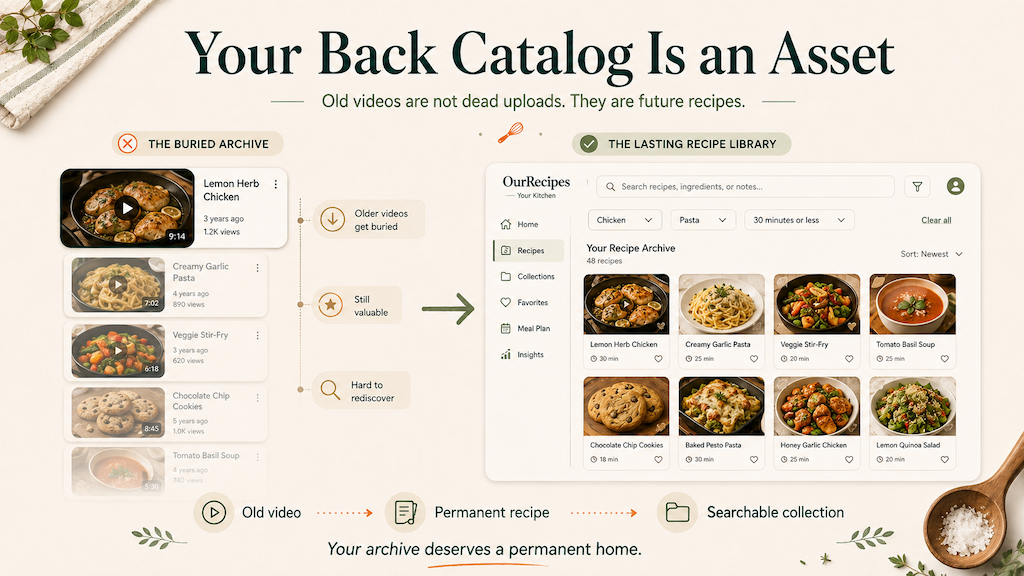
Creators naturally spend most of their attention on the next upload. That makes sense because social platforms reward a steady stream of new material. But after several years of publishing, an established cooking channel has accumulated something else: a substantial library of recipes that has already been developed, filmed and paid for.
If you have made 200 cooking videos, you may already have the beginnings of a 200-recipe cookbook sitting inside your channel. The problem is that older videos gradually disappear deeper into the archive. A viewer who discovered you six months ago may never encounter an excellent recipe you published three years earlier, and even longtime followers may have forgotten about it.
Turning those videos into permanent recipe pages changes the value of the archive. An older chicken recipe can sit beside something you published yesterday. People can search by ingredient, save recipes, organize them into collections and come back when they actually want to cook.
Instead of thinking of the back catalog as old content, it becomes the foundation of something that gets more useful every time you publish another recipe.
The real opportunity starts after the recipe
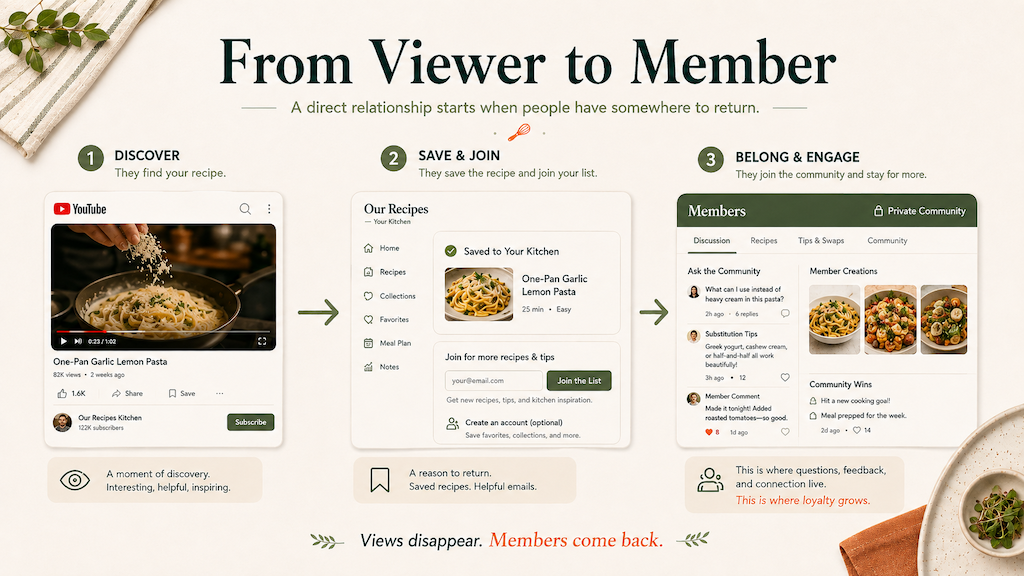
The recipe library solves an obvious problem, but the more interesting opportunity begins once viewers have a reason to return to you outside the feed.
Someone watches one of your videos and opens the recipe. They come back a few days later looking for another dinner idea and save that one too. Eventually they join your Kitchen because they would rather hear about new recipes directly from you than hope the algorithm happens to show them the next upload.
That changes the relationship. You now have a member you can reach rather than an anonymous viewer you have to reacquire every time you publish.
Cooking also lends itself unusually well to community. People naturally want to ask whether they can substitute an ingredient, show you how the recipe turned out, explain what went wrong, request something for a future video or talk with other people who enjoy the same kind of food.
Most of those conversations currently happen underneath individual social posts and then effectively disappear. A private community gives them somewhere to accumulate. Over time, the Kitchen can become a place people visit not only because they need tonight's recipe, but because they feel connected to the creator and the other people cooking alongside them.
From audience to subscription business
None of this means putting everything behind a paywall. Most of your audience should probably remain free because free content is what drives discovery, sharing and growth.
But established creators usually have a much smaller group of followers who want more than the average viewer. They may want access to the full archive, special recipes, curated collections, members-only conversations, direct interaction or simply a closer connection to someone whose food they have been cooking for years.
That is where a subscription can make sense. The idea isn't to charge someone $10 just to see an ingredient list. The subscription is membership in a more complete version of your Kitchen, with premium recipes, useful cooking tools, community and whatever additional access makes sense for your particular audience.
The economics do not require converting a large percentage of your viewers. Five hundred members paying $10 a month is $5,000 in recurring monthly revenue. A thousand members is $10,000 a month. For a creator with a substantial and loyal following, those members could represent a very small portion of the people already consuming the content.
This also doesn't require abandoning advertising or sponsorships. They monetize different parts of the audience relationship. Advertising monetizes broad attention, sponsorships monetize influence, and subscriptions monetize the deeper relationship with the relatively small number of people who care enough to become members. A healthy creator business can have all three.
Why not just Patreon or Substack?
Patreon and Substack have already demonstrated that people are willing to pay creators directly, and either can be a reasonable choice for some creators. The limitation for a cooking creator is that neither product was fundamentally designed around recipes.
Recipes have structure. They have ingredients, quantities, serving sizes and steps. People want to search them by what they want to cook, save favorites, scale quantities and use them on a phone while standing in the kitchen. A large recipe collection is fundamentally different from a chronological stream of posts or newsletters.
The same applies to community. If someone is cooking your pasta recipe, they should be able to ask a substitution question, see what other people made and participate in a conversation connected to that recipe rather than digging through an unrelated discussion feed.
Food creators can benefit from the same direct relationship that general membership platforms have pioneered. The difference is that the product underneath that relationship should understand how people actually use recipes.
Keep YouTube. Build your Kitchen.
OurRecipes is not an argument against YouTube, Instagram or TikTok. Quite the opposite. Those platforms are extraordinarily good at distributing video and introducing creators to audiences they could never reach on their own. They should continue doing that job.
Your Kitchen has a different job. It gives your recipes a permanent structure, gives viewers somewhere useful to return, lets people join an audience you can reach directly, creates a place for community around your cooking and gives your most loyal followers the option of becoming paying members.
Those pieces reinforce one another. Someone discovers you through a video, cooks one of your recipes, saves another, joins your Kitchen and eventually becomes part of the community. A small percentage may decide they want enough additional value to become subscribers.
That is a much more durable relationship than hoping the same person happens to see you the next time your thumbnail appears in their feed.
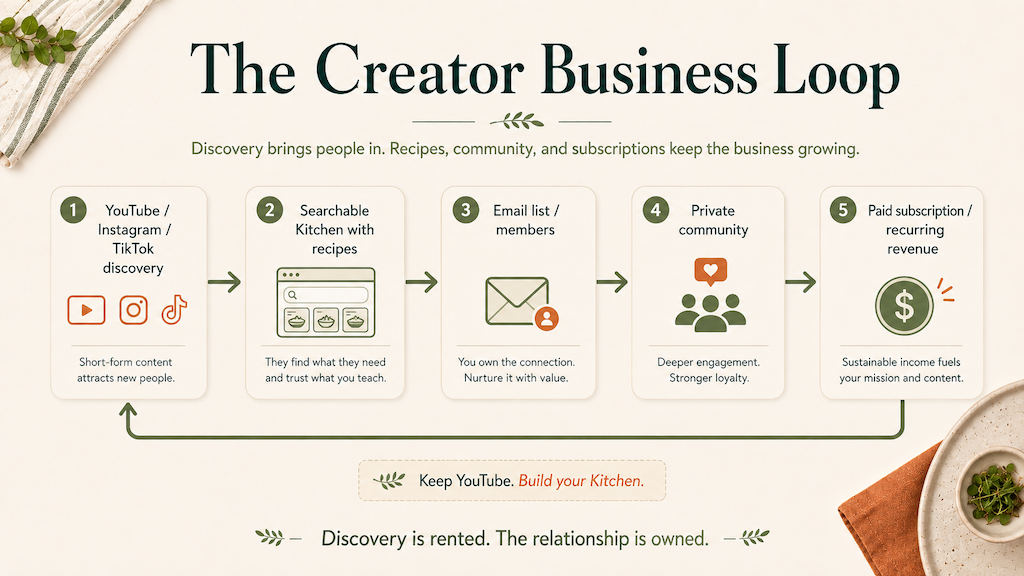
The point isn't to move your audience off YouTube or to recreate everything YouTube already does well. It is to stop asking a video platform to also serve as your recipe archive, customer database, community and entire business model.
Keep making the videos that built the audience in the first place. Just give the recipes, relationships and community that grow out of those videos somewhere permanent to live.
YouTube is where people discover your cooking. Your Kitchen is where the relationship lives.
Build your Kitchen, private community and subscription business at OurRecipes.co.
This version keeps all five original image paths exactly intact and avoids the chopped-up, one-line AI cadence.