Food Blogging Isn’t Dead. The Pageview-Only Business Is.
Summary
The food-creator business is changing. Search traffic and advertising still matter, but they are becoming a less reliable foundation as Google and AI platforms answer more questions without sending users to the original publisher.
The opportunity is not to abandon blogs, video or social media. It is to use them for discovery while building something more durable underneath: a searchable recipe library, a direct audience, paid subscriptions and a private community.
For food bloggers with years of recipes and declining traffic, that means finding new value in an archive they already own. For video creators, it means turning an audience they already earned into something more permanent than followers and views.
This paper looks at what is changing, what the data actually says, and why the next food-publishing model will combine broad reach with direct, recurring relationships.
The Pageview Era
For most of the past fifteen years, the food-publishing business followed a reliable formula: publish recipes, rank well on Google, attract a large audience, place advertisements around the content, and do it again.
For the creators who became good at it, this was a terrific business. One successful recipe could bring in traffic and advertising revenue for years. Build a large enough library, maintain strong search rankings, and a food blog could become a valuable media property.
There was always a weakness in the arrangement, though. The creator owned the recipe, but Google owned the path people took to find it.
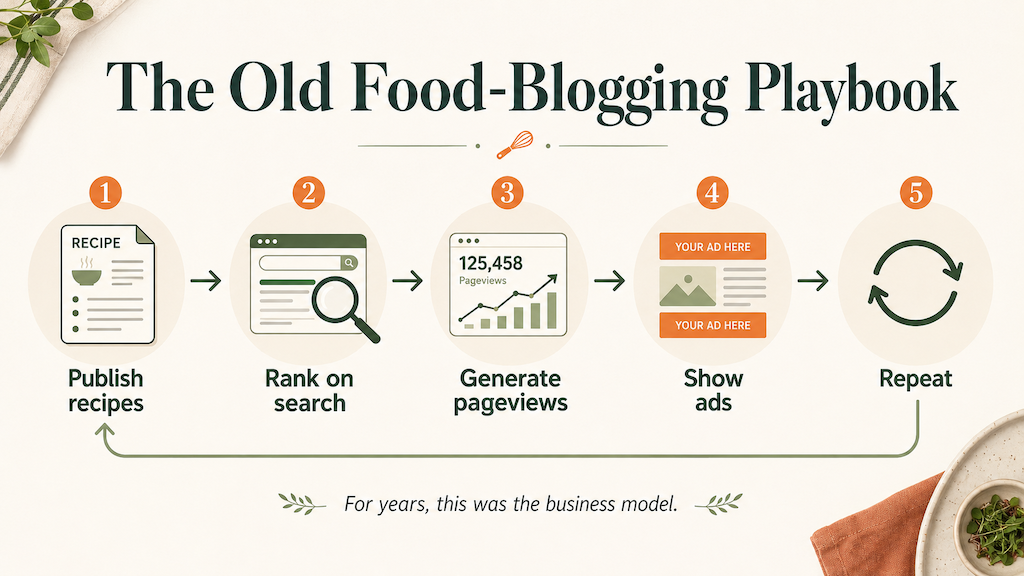
The old bargain: publishers supplied the recipes, and Google supplied the traffic.
Google used to send people somewhere
Traditional search worked like a directory. Someone searched for banana bread, Google displayed a list of pages, and the person clicked through to one of them. The publisher created the useful content and received the visit in return.
AI search changes that bargain. Google can now summarize the ingredients, outline the method, answer common questions and suggest substitutions directly on the search page. The user may get enough information to continue without visiting the person who created the recipe.
The shift is already visible in the data. Semrush reported in December 2025 that AI Overviews appeared for approximately 11% of the Food & Drink keywords it tracked, after faster growth in that category than in any other vertical during the year.
Pew Research Center examined almost 69,000 Google searches made by 900 American adults in March 2025. When an AI summary appeared, users clicked a conventional search result in 8% of visits. Without an AI summary, they clicked a result 15% of the time.
Ahrefs reached a similar conclusion using a different dataset. Its February 2026 analysis estimated that AI Overviews had reduced the click-through rate of the first organic result by 58% as of December 2025.
The studies use different methodologies, so no single percentage tells the whole story. The direction, however, is clear: when Google provides more of the answer, fewer people visit the publisher.
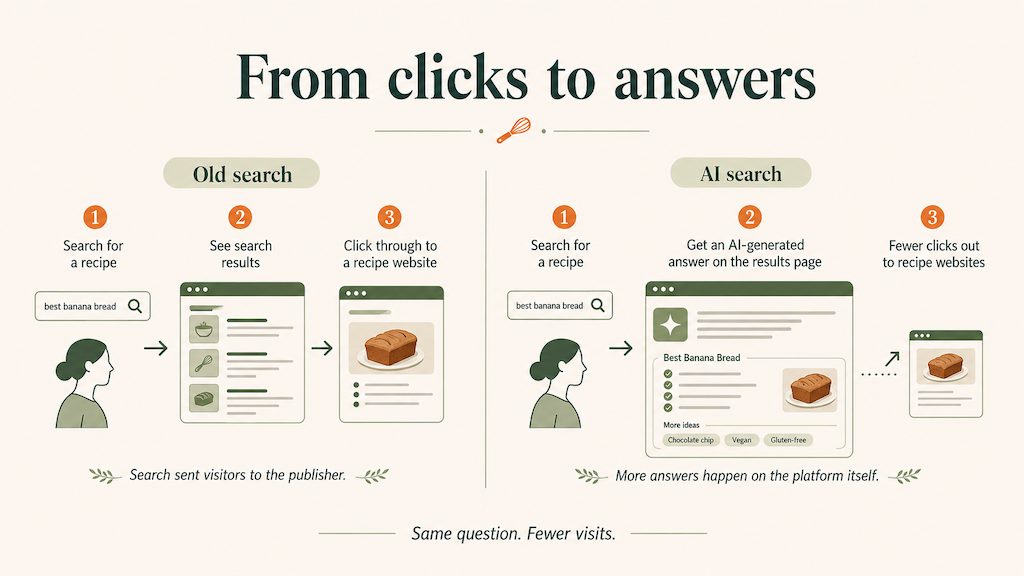
When the answer stays on the search platform, the publisher loses the visit.
This is more than another algorithm update
Food publishers have lived through countless Google updates. Rankings change, traffic falls, and publishers respond by updating old content, improving technical performance and adjusting their SEO strategies.
This change is more fundamental because Google is not merely deciding which website deserves the first position. It is reconsidering whether the user needs to visit a website at all.
SEO still matters. Recipe schema still matters. Search will continue sending meaningful traffic to food websites. But building an entire business around that traffic has become much riskier, because a publisher can do everything correctly and still lose visitors when Google changes the search experience itself.
That does not mean creators should abandon search. It means they should stop treating search traffic as the final destination.
Search should introduce people to the creator. The creator’s own recipe library, paid subscription and private community should give those people a reason to remain connected.
For food bloggers, this is especially important. Many have spent ten or fifteen years building large recipe archives that once produced dependable traffic and advertising income. The recipes still have value, and readers still want them. What has changed is the route people take to reach them—and whether they arrive at all.
The answer is not to abandon those archives. It is to build a more direct business around them.
A pageview is not necessarily an audience
Someone arrives through Google, closes a popup, scrolls past several advertisements, finds the ingredient list and leaves. The visit produces an ad impression and perhaps a few cents of revenue, but it does not create much of a lasting connection.
The visitor may not remember the creator’s name. They may never join the email list, watch a video or return for another recipe.
That model can still be profitable at scale. But anonymous traffic and a loyal audience are not the same asset.
A loyal audience knows who made the recipe. They recognize the creator’s voice, trust their judgment and deliberately return for more. They want to ask questions, compare results, share modifications and see what the creator is cooking next.
That is where a private community becomes valuable.
A private community gives the audience a place to interact with the creator and with one another without being buried beneath an algorithmic feed. It turns cooking from a one-way publishing activity into an ongoing relationship.
A paid subscription gives that relationship an economic foundation. Instead of earning only when an anonymous visitor loads an advertisement, the creator earns recurring revenue from readers and viewers who actively choose to remain part of the Kitchen.
Some creators built this trust through YouTube or Instagram. Others built it through years of blog posts, newsletters, cookbooks and reader comments. The format matters less than the relationship behind it.
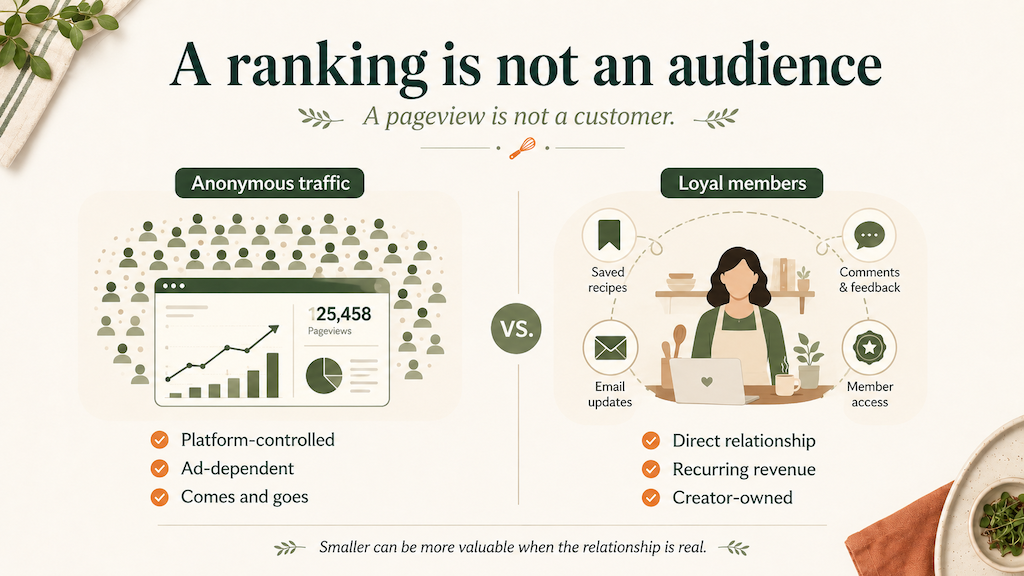
Anonymous traffic produces impressions. Loyal members create a business.
Trust is the part AI cannot easily copy
There is no shortage of recipes online. People return to a particular creator because they trust that person’s taste, technique and judgment.
An AI answer can say how much flour belongs in a loaf of bread. It cannot fully reproduce the relationship created after someone has cooked from the same blog for ten years, watched the same chef prepare hundreds of meals or received a thoughtful answer to a question.
Unfortunately, creators still monetize much of that trust indirectly. Google determines whether an old recipe receives traffic. YouTube decides how widely a new video is distributed. Advertisers determine what the attention is worth, and sponsors decide whether a creator fits the next campaign.
The creator built the trust, but outside platforms still control most of the transaction.
A private community and subscription model bring that transaction closer to the creator. The audience is no longer simply consuming content around advertisements. Members are paying for continued access to the creator’s recipes, judgment, community and ongoing work.
I have spent most of my career building software businesses, and one lesson has remained consistent: the strongest business is the one with a direct relationship to its customer.
I did not start OurRecipes because the internet needed another place to publish recipes. I started it because food creators had already built valuable bodies of work and loyal audiences without having a product designed to turn that trust into a searchable recipe library, a paid subscription and a private community.
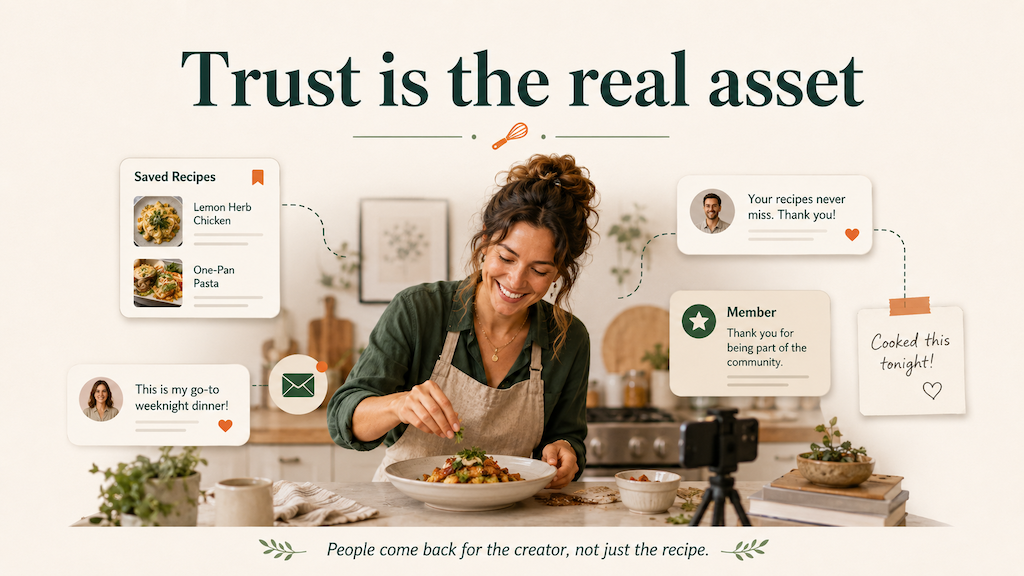
People return for the creator’s judgment, personality and point of view—not merely a list of ingredients.
Why not just use Substack or Patreon?
Substack and Patreon have already proved that people will pay creators directly. Substack reported passing five million paid subscriptions in March 2025, while Patreon has built a large business around recurring creator memberships.
They are good products, but recipes are not ordinary posts.
A useful recipe needs structured ingredients and steps. It should scale for different serving sizes, remain readable while someone is cooking, be searchable across a creator’s entire library and connect naturally to the original article or video. Over time, it should support saved collections, shopping lists, substitutions, timers and the other details that make a recipe useful in a real kitchen.
A newsletter platform is built to deliver writing. A general membership platform is built to place content behind a paywall.
Food creators need more than a generic paywall.
They need subscriptions organized around cooking, with recipes that remain useful after they are published. They need private communities where members can ask about substitutions, share photographs, discuss techniques and interact with people who cook the same food.
The subscription and the community should live beside the recipes, not in a separate product that treats a recipe like an ordinary newsletter post.
That distinction matters for both kinds of creators.
A food blogger may already have hundreds or thousands of recipes buried in an aging website archive. A video creator may have years of recipes trapped inside videos. In both cases, the creator has valuable work and an existing audience, but no simple place where that audience can search the full library, subscribe and participate in a private community.
That is the space OurRecipes is being built for.
The math should be honest
Membership pitches often jump directly to “1,000 true fans” without explaining how difficult it is to acquire them.
A creator with 100,000 social followers should not assume that 1,000 people will immediately pay. Many followers are inactive. Not everyone sees a launch announcement, and only a portion of those who see it will visit the offer.
The same applies to blogs. A website receiving 500,000 monthly pageviews does not necessarily have 500,000 loyal readers. Much of that traffic may come from one-time Google searches.
The useful number is not total followers or total pageviews. It is the number of people who regularly return, open emails, save recipes, leave comments and recognize the creator by name.
To reach 500 paying members, a creator might need 25,000 genuinely reachable fans converting at 2%, or 50,000 converting at 1%. Those are scenarios, not promises. Some creators will perform better and many will perform worse. The offer, price, publishing frequency, community activity and strength of the relationship all matter.
At $10 per month, 500 members produce $5,000 in monthly recurring revenue before fees and cancellations.
For comparison, a website earning an illustrative $20 in advertising revenue per thousand pageviews would need approximately 250,000 monthly pageviews to produce the same $5,000. Actual page RPMs vary widely, but the comparison shows the difference between the two models.
One depends on hundreds of thousands of mostly anonymous visits every month. The other depends on a much smaller group deliberately choosing to subscribe and become part of the creator’s community.
Advertising and subscriptions do not have to compete. A creator can use both.
Advertising monetizes broad traffic. A paid subscription and private community monetize the deeper relationship with the readers and viewers who care most.
What OurRecipes is building
OurRecipes gives food creators a structured, searchable Kitchen built around their work.
For bloggers, that means giving an existing recipe archive a cleaner, more direct relationship with readers instead of leaving every recipe dependent on a Google search.
For video creators, it means turning recipes demonstrated on camera into organized, usable recipe pages.
Followers can search the creator’s entire library, save recipes and cook from them. They can join the creator’s private community, ask questions, share what they made and interact with other members.
Creators can continue offering free recipes while reserving additional recipes, collections, cooking series and community access for paid subscribers.
The subscription is not simply a charge to view a recipe. It supports an ongoing relationship that includes useful recipe tools, continued access to the creator and participation in a private community centered on the food.
OurRecipes is not intended to replace a creator’s existing blog, YouTube channel, Instagram account or search traffic. Those channels remain valuable ways to reach people.
The goal is to add the layer most creators are missing: recurring subscription revenue and a private community they can build around an audience they have already earned.
Use the large platforms for discovery. Use the blog, video channel and social presence to build trust. Then give the people who care most a Kitchen where they can subscribe, participate and stay.
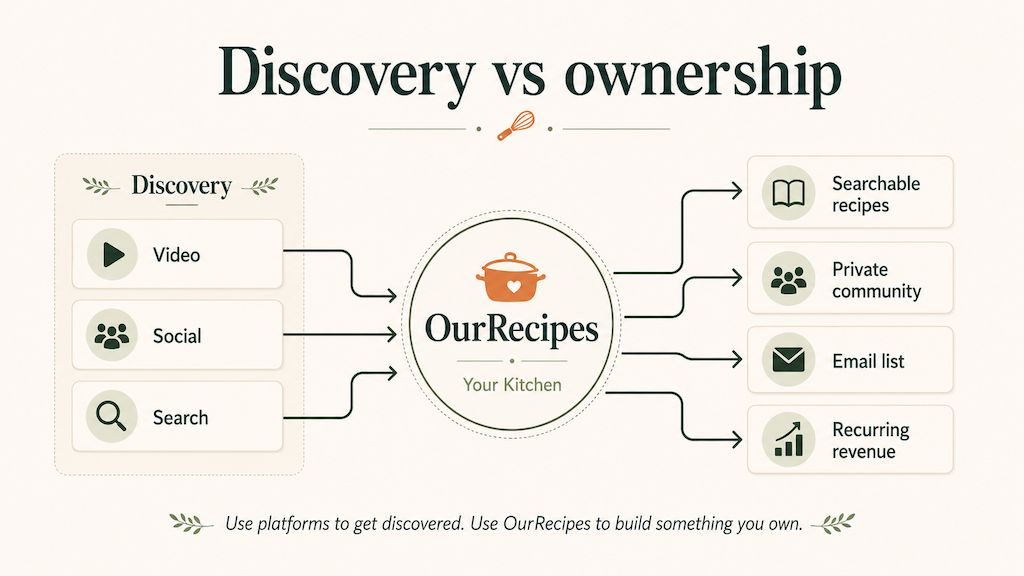
Platforms create discovery. A subscription and private community create the relationship.
The next food business will use both models
Food blogging is not dead, and neither is advertising. Search will continue producing traffic, and successful publishers should continue earning money from it.
What is ending is the period when creators could safely treat pageviews as the entire business.
The next generation of food businesses will combine broad distribution with direct relationships. Search, video, social media and existing blogs will bring people in. A searchable recipe library will organize the work. Paid subscriptions will create predictable recurring revenue. Private communities will give readers and viewers a reason to stay involved.
For a blogger with a large archive and declining traffic, the answer is not to throw away years of work. It is to stop allowing Google and advertising networks to be the only way that work creates value.
For a video creator with hundreds of recipes buried inside a channel, the answer is similar. The content already exists. The audience already exists. What is missing is a permanent product that connects the recipes, the subscription and the community.
The old food-publishing business was built around how many people passed through.
The next one will be built around how many people subscribe, participate and come back.
Build your Kitchen, private community and subscription business at OurRecipes.co.